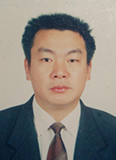
| Researcher Lifu Gao, Hefei Institutes of Physical Science, Chinese Academy of Sciences, ChinaGao Lifu is a researcher and doctoral supervisor of Hefei Institute of Material Science, China Academy of Sciences. He is currently the deputy director of the Institute of Intelligent Machinery. His main research direction is robot sensing and intelligent control. He has presided over national-level projects such as the theme project of robot technology in the National 863 Program and the development of ITER major special equipment. The aerospace six-axis force sensor developed by his team has realized the first on-orbit full information detection in China. |
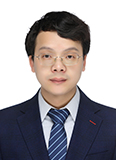
Prof. Zhiqiang Miao, Hunan University, ChinaZhiqiang Miao is currently a Professor with the School of Artificial Intelligence and Robotics, Hunan University. He received the B.S. and Ph.D. degrees in electrical and information engineering from Hunan University, Changsha, China, in 2010 and 2016, respectively. From 2014 to 2015, he was a Visiting Scholar with the University of New Mexico, Albuquerque, NM, USA. From 2016 to 2018, he was a Postdoc Fellow with the Department of Mechanical and Automation Engineering, The Chinese University of Hong Kong, Hong Kong, China. His research interests include robotics, multirobot systems, visual navigation, and nonlinear control. Prof. Miao was the recipient of the IEEE Robotics and Automation Letters Best Paper Honorable Mention Award in 2020, the Outstanding Doctoral Dissertation Nomination Award of Chinese Association of Automation in 2018, and the Outstanding Reviewer of IEEE Journal of Oceanic Engineering in 2022. He is serving as an Associate Editor of IEEE Transactions on Automation Science and Engineering, and a member of IEEE CSS Conference Editorial Board.He is (was) an Associate Editor for the ICRA, IROS, and ACC. |
|
| Prof. Guangdeng Zong, Tiangong University, ChinaGuangdeng Zong (Senior Member, IEEE) received the B.S. degree and M.S. degree in mathematics from Qufu Normal University, Qufu, China, in 1999 and 2002, respectively. In 2005, he received the Ph.D. degree in control theory and control engineering from School of Automation, Southeast University, Nanjing, China. He was Associate Professor and Full professor at the Qufu Normal University (2005-2021) and currently Full Professor at the Tiangong University (since 2022). He was a Postdoctor with the School of Automation, at the Nanjing University of Science and Technology, from 2006 to 2009. In 2010, he was a Visiting Professor with the Department of Electrical and Computer Engineering, Utah State University, Logan, U.T., USA. In 2012, he was a Visiting Fellow with the School of Computing, Engineering and Mathematics, University of Western Sydney, Penrith, Australia. In 2016, he was a Visiting Professor with the Institute of Information Science, Academia Sinica, Taipei, Taiwan. From 2018 to 2019, he visited the Department of Mechanical Engineering, The University of Hong Kong, Hong Kong. From 2019 to 2020, he visited the Department of Mechanical Engineering, The University of Victoria, Victoria, B.C., Canada. He has published over 300 refereed journal and conference papers on nonlinear control systems, switched systems, time-delay systems, networked control systems and robot control. He is currently an Editorial Board Member for some international journals, such as IEEE/ASME Transactions on Mechatronics、IEEE Systems Journal. |

Researcher Abdulkabir Aliyu, Universiti Teknikal Malaysia Melaka, MalaysiaDr. Abdulkabir Aliyu is a distinguished Chemical Engineering academic, researcher, and industry professional with over a decade of experience across refining and petrochemical operations, higher education, and applied sustainability research. He earned his PhD from Cranfield University, United Kingdom, and possesses specialized expertise in alternative fuels, clean energy technologies, and transport phenomena. His work emphasizes the integration of renewable and alternative fuels into existing energy systems, delivering measurable reductions in greenhouse gas emissions and carbon footprints. Dr. Aliyu has led high-impact, interdisciplinary initiatives involving academia, industry, and government-linked organizations, and is highly regarded for stakeholder engagement, competitive research grant acquisition, and cross-sector collaboration. His professional portfolio includes Research Workflow 4.0, leveraging Scopus AI and AI writing agents, generative AI in academic publishing, educational leadership, blended learning implementation, peer review for international journals, and student mentorship. A seasoned public speaker, he is widely recognized for translating technical innovation into actionable strategies that inform policy, industrial practice, and sustainable development. |
|
